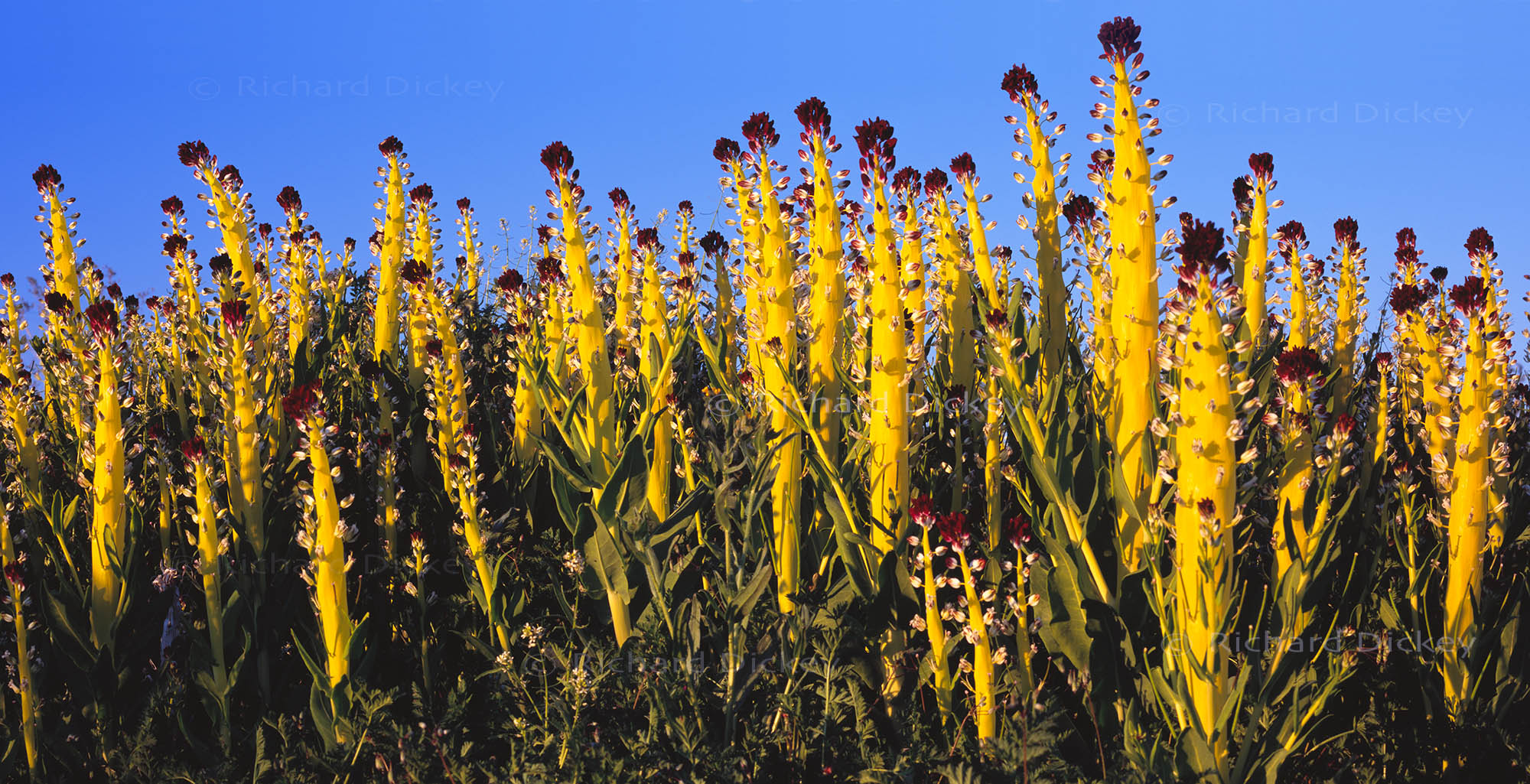
Mojave Desert, California · 2005
California Wildflower Photography Archive
Earth’s Most Elusive Wildflower Landscapes
For four decades, photographer Richard Dickey has documented California’s most elusive wildflower landscapes—fleeting moments when the right mix of rain, temperature and sunlight transforms entire hillsides into bursts of color. Long before the term “Super Bloom” entered popular culture, these extraordinary events were known to a small circle of naturalists and photographers as “carpet blooms.” These photographs preserve transient moments in nature—glimpses of an ecological world that may never be repeated.
Taken together, this archive represents the earliest long-term photographic record of California’s large-scale wildflower “carpet blooms”—ecological events that later became widely known as Super Blooms.
A Fleeting Landscape, Captured at Extraordinary Scale
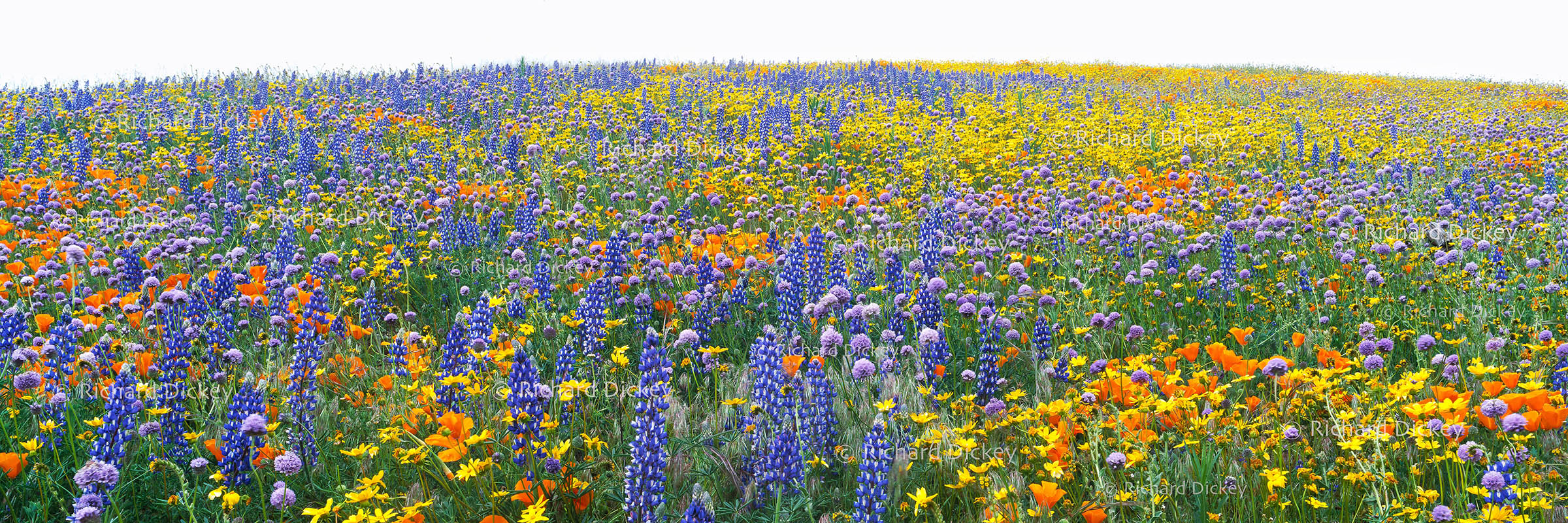
Much of the archive was photographed on 35mm transparency film and with the Fuji GX617 panoramic camera. Introduced into the project in 1991, the GX617 uses a large 6×17 cm film frame to produce a true 3:1 panoramic image.
A single GX617 transparency contains nearly eleven times the image area of a traditional 35mm frame and approximately 2.8 times the visible image area of a 15/70 IMAX frame. The format became especially valuable for documenting wildflower landscapes that extended far beyond the boundaries of a conventional photograph.
Across hills, valleys and fault-lined basins, these large transparencies preserve the tonal richness, depth and immense scale of blooms that may appear only once in a generation, if ever.
When displayed at architectural, wall-sized scale, these panoramic photographs reveal an astonishing range of detail across the landscape—from individual flowers to immense fields containing millions of blooms. The experience feels less like viewing a photograph and more like being immersed in the landscape.
Inside a Fuji GX617 Transparency
Tap the magnifiers to explore the remarkable detail, texture and individual wildflowers preserved within a single Fuji GX617 panoramic transparency.
Ecological & Historical Context
These blooms are born from an extreme land shaped by drought, episodic rains, shifting climates and deep ecological time. Seeds lie dormant for decades, awaiting precise conditions. When they emerge, they create a phenomenon both fragile and overwhelming—a force of nature that feels as much physical as visual.
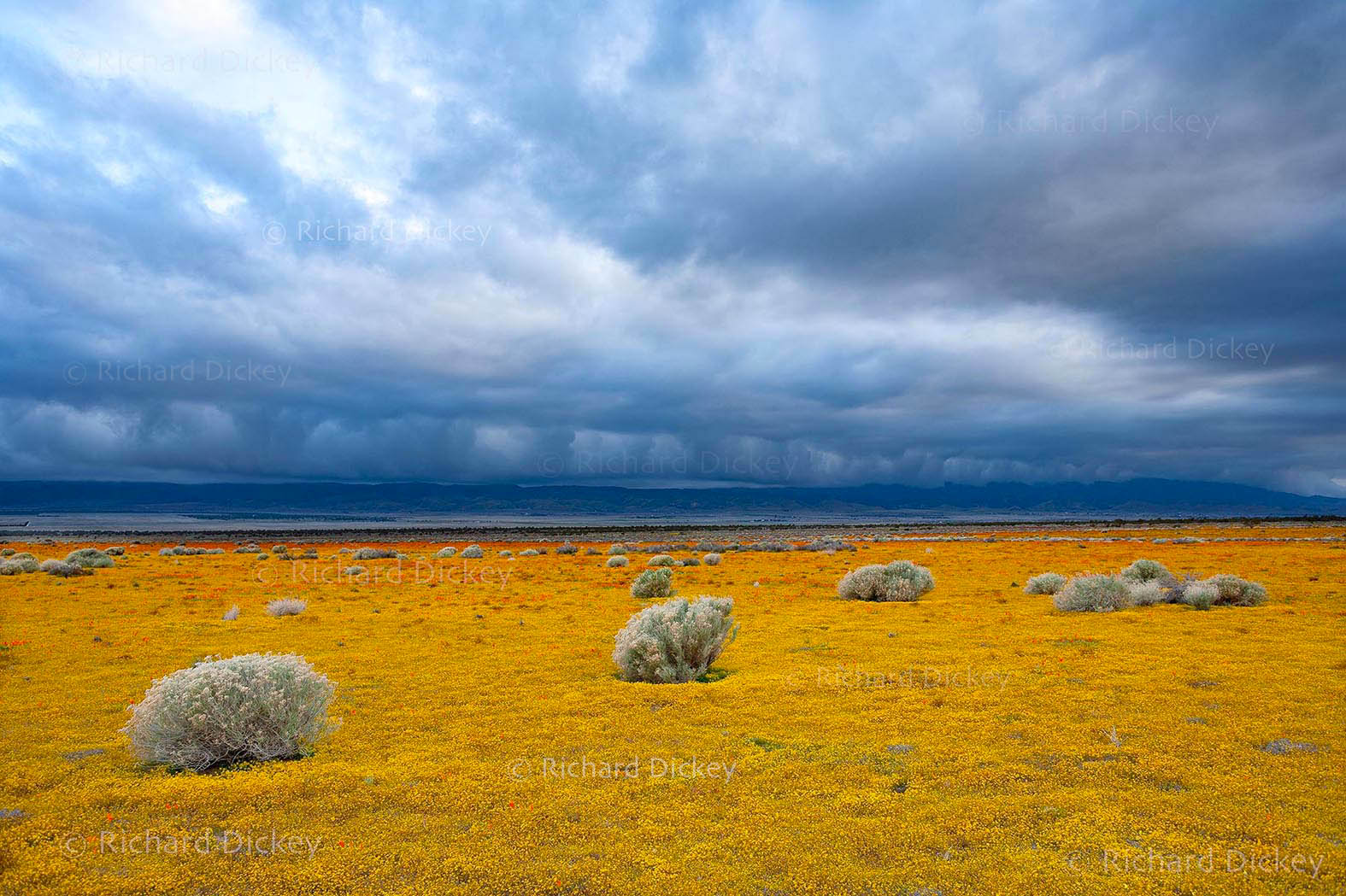
The calm before the storm—rolling clouds gather above a vast carpet of spring wildflowers in Antelope Valley, California · 2006
A Biodiversity Hotspot
California’s native plants are part of the California Floristic Province—one of the world’s great biodiversity hotspots—where an extraordinary concentration of endemic species has evolved through cycles of scarcity and abundance, relying on dormancy and sudden, explosive growth to survive an unpredictable climate. This biodiversity hotspot is a zone of Mediterranean-type climate and is characterized by hot, dry summers and cool, wet winters. The province encompasses a wide range of habitats, from coastal sage scrub and oak woodlands to alpine peaks and desert margins. Across these varied environments, more than 3,000 vascular plant species have been recorded, with roughly 60 percent found nowhere else on Earth. This high level of endemism reflects a long history of isolation, adaptation and ecological specialization.
A Landscape with a Human History
Early Spanish explorers described California as la tierra del fuego—a land seemingly set ablaze by fields of brilliant orange flowers stretching to the horizon. Nineteenth-century settlers wrote of immense wildflower pastures from San Francisco to San Diego and communities celebrated spring with festivals honoring this natural heritage. Most importantly, Native Americans revered and cherished the land’s floral rebirth after winter, utilizing California’s native plants for food, medicine, clothing and shelter.
An Unpredictable Convergence
Among the California Floristic Province, vast wildflower blooms are the most unpredictable, governed by a delicate interplay of water, soil, sunlight, temperature, insects, grazing herbivores, fire and time. When they occur, the landscape becomes a living, breathing expression of the ecosystem itself—an extraordinary surge of life that feeds, connects and sustains the countless species that share it.
Disappearing Landscapes
Many of the locations documented here are increasingly threatened by development, invasive species, agriculture and climate pressures. Areas once famous for vast wildflower displays—including regions now absorbed by urban expansion—exist today only in memory and photographs.
This work stands as both celebration and record: a visual chronicle of landscapes that are changing and in some cases quietly disappearing.

Experience of Bloom
To witness a major bloom is to feel immersed in color, fragrance, light and motion. Flowers open and close with the sun, ephemeral species appear at dusk and vanish by morning and entire hillsides shift in tone as the day unfolds. Through these photographs, the intention is to offer viewers a sense of presence—an invitation to witness a rare convergence of time, climate and living systems.
Feral Flowers is a 40-year photographic archive dedicated to preserving landscapes once in bloom—many irreversibly altered by development and land use—ensuring their presence endures in memory and record.
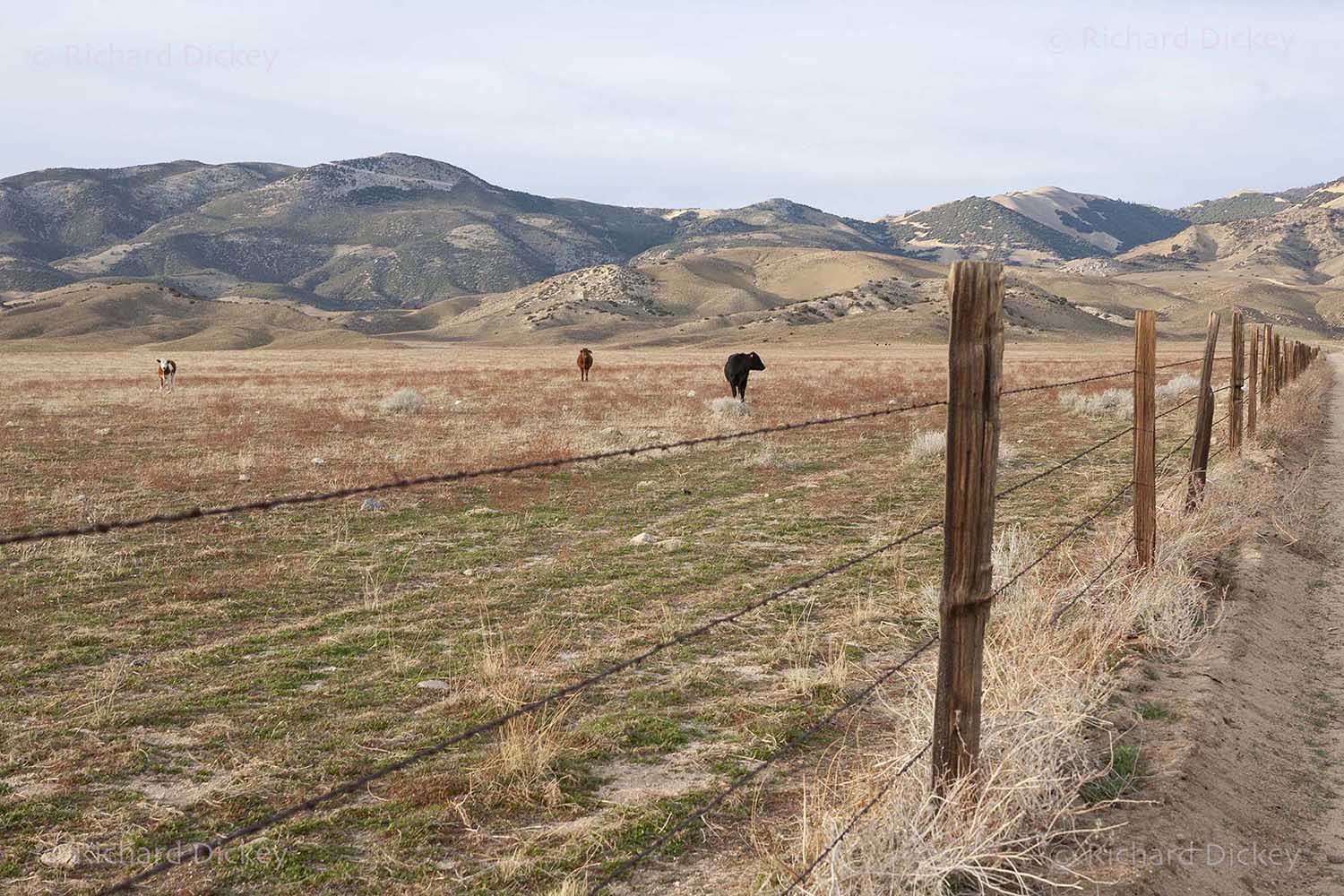
Feral Flowers Project
The term FERAL is taken from the old Latin meaning “of the wild” or “from the wild” and is a separate translation closely related to “once domesticated and returned to the wild,” which is more contemporary.
This project began in 1986 and has grown organically over decades—rooted in observation, persistence and transformation. The archive brings together archival materials, Field Notes, photographic records and reflections that had never previously been gathered in one place.
Among these materials are long-term documentations of the Hills of Gorman, California—once considered the crown jewel of California’s recurring Super Blooms. Between the 1970s and the early 2000s, the hills burst into wildflower displays every three to five years, reaching their peak with California’s largest and most diverse Super Bloom in 2003. A 2,800-acre wildflower preserve was even proposed by UCLA Extension. Then, the bloom cycles gradually ceased. And now they’re gone.
What happened? The answer holds a few intriguing insights—including an unexpected connection to a prominent grocery store chain. The expanded archive quietly explores this question and others.
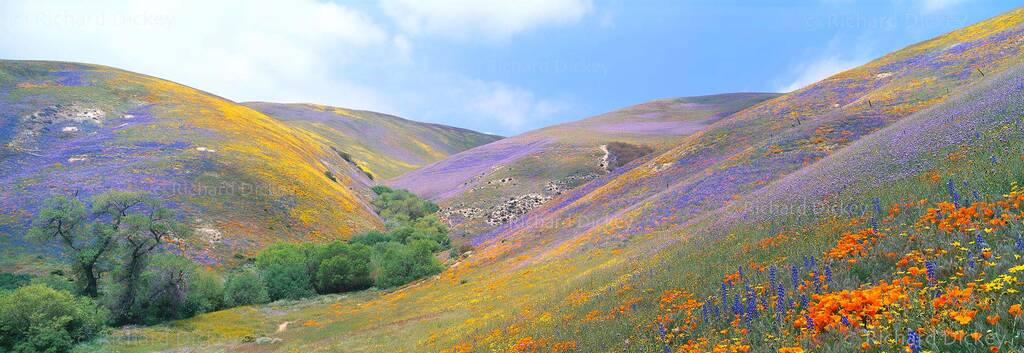
Gorman, California · Fuji GX617 Panoramic Film
When this work began in the mid-1980s, very few people were documenting California’s large-scale wildflower blooms. Today these spectacular events—widely shared across social media—are commonly called Super Blooms. What began as a personal effort to understand when and where these rare landscapes appeared gradually became a long-term visual record of some of California’s most extraordinary and ephemeral natural events.
The archive will continue to expand as additional photographs, Field Notes and historical material from this decades-long body of work are brought online.
Four Decades of Landscapes in Bloom
What Defines a Super Bloom?
Discover why true Super Blooms are among California’s rarest and most remarkable natural events.
Continue Reading →